A leaking commercial roof does not automatically need to be replaced.
That may sound obvious, but once water starts appearing inside a building, it is easy for the conversation to jump immediately from “we have a leak” to “how much is a new roof going to cost?”
In many cases, a targeted repair is exactly what the roof needs. A damaged flashing detail, punctured membrane, blocked drain, or failed seam can often be corrected without disturbing the rest of a roofing system that may still have years of useful service left.
There is a point, however, when repeatedly repairing an aging roof stops making financial sense.
The difficult part for a property owner is figuring out where that line is.
A good roofing assessment should answer more than whether a roof can be repaired. It should help determine whether repairing it is still the best use of your money.
For commercial property owners, builders, and facility managers, that distinction matters. Roof replacement is a significant capital expense, but so is spending thousands of dollars every year repairing a roofing system that is steadily approaching the end of its service life.
The goal should be to make that decision based on the condition of the roof, not simply on the presence of a leak.
A Roof Leak and a Roof Failure Are Not the Same Thing
Water inside the building is usually the symptom that gets everyone’s attention, but it tells you surprisingly little about the overall condition of the roof.
A relatively new roof can leak because one small detail has failed. A much older roof can sometimes remain watertight even though large portions of the system are deteriorating.
That is why the first question should not be, “Is the roof leaking?”
The better question is, “Why is the roof leaking, and what does that tell us about the rest of the roofing system?”
If an inspection finds one isolated puncture in an otherwise healthy membrane, replacement would obviously be excessive. Repair the damaged area, confirm that no moisture has migrated into the insulation, and continue maintaining the roof.
If the inspection reveals open seams in several areas, deteriorated flashing, recurring ponding water, saturated insulation, and evidence of previous repairs throughout the roof, the situation is very different.
The leak may still be repairable, but the larger problem is that the roof itself is becoming unreliable.
When Does a Commercial Roof Usually Make Sense to Repair?
Repairs are most effective when the underlying roofing system is still fundamentally sound.
That generally means the problem is identifiable, reasonably contained, and occurring on a roof that still has useful service life remaining.
Typical examples include a puncture caused by another contractor working on the roof, damage around an HVAC curb, a localized flashing failure, a blocked drain, or a membrane seam that has begun to open.
The age of the roof also matters, but age should never be considered in isolation. A well installed and properly maintained roof may continue performing long beyond the point when another roof of the same age has started developing significant problems.
A repair tends to make sense when:
- The damage is limited to one or a small number of areas.
- The surrounding membrane remains in reasonable condition.
- Wet insulation is limited or nonexistent.
- The roof has not developed a pattern of recurring leaks.
- Drainage is functioning properly.
- The roof still has meaningful service life remaining.
This is where a professional inspection becomes particularly valuable. The visible leak is only part of the assessment. The condition of the membrane, insulation, flashing, penetrations, drainage system, and previous repair areas all help determine whether the problem is isolated or part of a larger pattern.
Garcia’s Insight
A repair should solve a problem, not simply move it somewhere else.
When one area of an older roof is repaired but another leak appears several months later, it does not necessarily mean the original repair failed. It may mean the roofing system has reached a point where different components are beginning to deteriorate at roughly the same time, like a high-milage car.
That pattern is often more important than any individual leak.
When Does Replacement Start to Make More Sense?
There is rarely one dramatic moment when a roof suddenly becomes “too old to repair.”
More often, the economics change gradually.
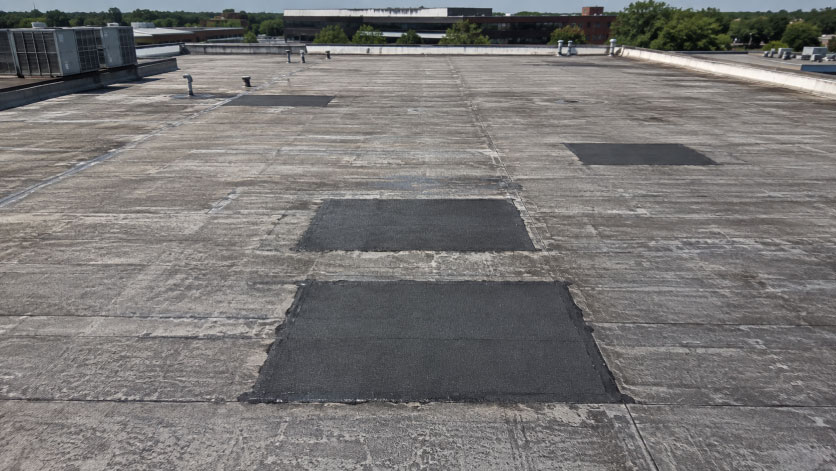
A property owner may initially spend a modest amount correcting an isolated leak. A few years later, another area requires attention. Then another. Eventually, repair costs become frequent enough that the owner is effectively investing in a roof that continues to decline.
At that point, the question is no longer whether another repair is possible. In most cases, it probably is. The question becomes whether the repair meaningfully changes the future of the roof.
Recurring Leaks Across Different Areas
One leak can be from a defect or acute damage. Repeated leaks across unrelated areas usually tell a larger story.
If repairs are being performed in one section of the roof while new problems continue appearing elsewhere, the roofing system may be experiencing widespread aging rather than isolated damage.
This is particularly important for commercial buildings because the cost of a leak extends beyond the roofing repair itself. Water can damage ceiling systems, insulation, inventory, electrical equipment, interior finishes, and tenant spaces. Even relatively minor leaks can create operational disruption.
A maintenance history is extremely useful here. Looking at several years of service records can reveal whether repair frequency is increasing.
Widespread Membrane Deterioration
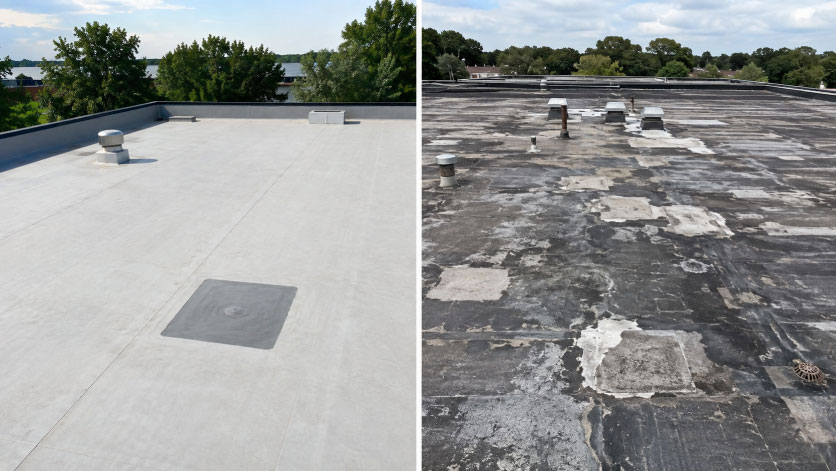
Roofing membranes change as they age. Depending on the system, you may see cracking, surface erosion, loss of flexibility, blistering, open seams, shrinking, or deterioration around penetrations and flashing details.
One deteriorated area can often be repaired. When deterioration is occurring across a large percentage of the roof, repairs become much less effective because the contractor is trying to preserve individual sections of a system that is declining as a whole.
You are no longer fixing an abnormal defect. You are addressing normal end of life deterioration.
Wet or Damaged Insulation
One of the most important parts of a commercial roofing assessment is what cannot be seen from the surface.
Water that passes through the membrane can become trapped inside the roofing assembly. Once insulation becomes saturated, simply repairing the membrane above it may not solve the entire problem.
Wet insulation can reduce thermal performance and allow moisture to spread beyond the original leak location.
The extent of moisture within the roofing assembly can therefore have a major influence on whether repair or replacement is appropriate. A small isolated wet area may be removed and replaced locally. Widespread moisture can make a larger restoration or complete replacement considerably more practical.
Repair History Is Becoming Expensive
There is no universal dollar amount where repair automatically becomes replacement. Building size, roofing system, accessibility, equipment, insulation, drainage, and membrane condition all influence the equation.
What property owners should pay attention to is the trend.
Consider two buildings with roofs of approximately the same age:
| Roof A | Roof B |
|---|---|
| One small repair in three years | Multiple service calls every year |
| No known wet insulation | Moisture found in several areas |
| Membrane generally sound | Numerous patches and deteriorated seams |
| Predictable maintenance costs | Increasing repair costs |
| No interior disruption | Repeated tenant complaints |
Both roofs may technically be repairable. Financially, however, they represent very different situations.
Roof A probably has useful life worth protecting. Roof B may be consuming maintenance dollars without providing much confidence in return.
The Roof Is Approaching the End of Its Expected Service Life
Roof age is useful as context, but it should not be treated like an expiration date.
Commercial roofing systems can perform very differently depending on installation quality, material, drainage, maintenance history, exposure, insulation design, and the amount of traffic the roof receives.
Ontario adds another variable because roofing systems are exposed to significant seasonal changes. Summer heat, winter cold, snow accumulation, ice, heavy rain, and repeated freezing and thawing all place stress on the roofing assembly.
An older roof that has been regularly inspected and maintained can sometimes outperform a much younger roof that was poorly installed or neglected. Still, once a roof reaches the later part of its expected lifespan, major repair decisions deserve more scrutiny.
Spending heavily to rehabilitate a roof that is likely to require replacement in the near future can amount to paying for the same problem twice.
For a more detailed look at service life, see our guide to how long commercial flat roofs last in Ontario.
Repair, Restore, Recover, or Replace?
It is also worth understanding that commercial roofing decisions are not always limited to two options.
Depending on the existing roof and its condition, there may be several possible approaches.
| Option | Best Suited For | General Purpose |
| Local repair | Isolated defects | Correct a specific problem while preserving the existing roof |
| Restoration | Aging but serviceable roofs | Extend service life through repairs, coatings, or other rehabilitation |
| Roof recover | Suitable existing assemblies | Install a new roofing system over an acceptable existing roof |
| Full replacement | Widespread deterioration or moisture | Remove the existing system and rebuild the roofing assembly |
A roof recover can sometimes provide significant value because it reduces demolition and disposal, but it is not appropriate for every building. Existing moisture, structural conditions, local requirements, the number of existing roof layers, insulation condition, and manufacturer specifications all need to be considered.
Likewise, restoration can be valuable when the roof is aging but still structurally and functionally sound.
The important point is that a good roofing contractor should be evaluating the available options rather than automatically recommending the most expensive one.
The Cost of Replacement Should Be Compared With the Cost of Keeping the Roof
A new commercial roof is expensive, which naturally encourages owners to postpone replacement for as long as possible. There is nothing wrong with that approach if the existing roof remains reliable. In fact, extending the useful life of a commercial roof through appropriate maintenance and timely repairs is usually good asset management.
The problem begins when delaying replacement starts generating its own costs. Those costs can include repeated service calls, emergency repairs, damaged insulation, interior restoration, lost inventory, tenant complaints, operational interruptions, and staff time spent managing recurring problems.
This is why replacement decisions should be based on total cost rather than the quotation for the roofing work alone.
A less expensive repair may seem attractive compared with a major replacement project. If similar repairs are required several times over the next few years, or if the next leak requires more than just a roof repair, however, the calculation begins to change.
Replacement also gives property owners the opportunity to address issues that individual repairs cannot easily solve, including insulation performance, drainage improvements, obsolete details, and weaknesses in the original roof design.
Read more about Flat Roof Cost in Ontario.
Can You Wait Another Year?
Sometimes the answer is yes.
Commercial capital planning rarely happens in a vacuum. A building owner may know that a roof needs replacement but need time to allocate funds, coordinate tenant requirements, arrange financing, or align the work with other improvements.
A roofing contractor should be able to help determine whether the existing roof can realistically be stabilized for another season. That might involve repairing known deficiencies, improving drainage, addressing vulnerable flashing details, and establishing a more frequent inspection schedule.
The key is understanding the difference between extending a roof intentionally and simply postponing a problem. If the roof can reasonably be maintained while a replacement is planned, that can be a sound strategy. If moisture is spreading through the system and new failures are occurring regularly, waiting may ultimately make the project more expensive.
Common Mistake: Waiting for a Major Leak Before Planning Replacement
One of the worst times to start planning a commercial roof replacement is when water is already entering the building. At that point, the project becomes reactive.
There is pressure to stop the leak quickly, budgeting becomes more difficult, and the owner may have less time to evaluate roofing systems, contractors, warranties, insulation options, and project schedules. An inspection program gives owners the opportunity to see replacement coming.
Ideally, you should know that a roof is approaching the end of its useful life several years before it actually becomes unreliable. That creates time to budget properly and choose the right roofing solution instead of making a major capital decision under pressure.
What Should a Roofing Contractor Explain Before Recommending Replacement?
If a contractor recommends replacing a commercial roof, you should understand why.
“You need a new roof” is not enough information.
The recommendation should be connected to observable conditions such as membrane deterioration, moisture, repeated failures, insulation damage, flashing condition, drainage concerns, or the overall repair history.
Property owners should also understand what alternatives were considered. Could portions of the roof be repaired? Is restoration realistic? Could the existing system support a recover? How much service life could another significant repair reasonably provide?
There may not be a perfect answer, but there should be a logical explanation.
That is particularly important with commercial roofing because the least expensive option today is not necessarily the least expensive option over the next ten or twenty years.
Read more about how to choose a roofing contractor in Ontario.
How Garcia Roofing Approaches the Decision
At Garcia Roofing, the objective is not simply to determine whether a roof can be repaired.
The objective is to understand what condition the roofing system is actually in, what the owner is trying to accomplish, and which option provides the most sensible path forward.
Sometimes that means a relatively small repair. Sometimes it means maintaining the existing roof while the owner plans a replacement several years from now. In other cases, the amount of deterioration or moisture makes continued repair difficult to justify.
Garcia Roofing works with commercial flat roofing systems throughout Ontario and holds seven manufacturer certifications. That experience allows our team to evaluate different roofing systems and recommend solutions based on the building rather than forcing every project into the same approach.
We’re not just here for today, we’re here for tomorrow.
Frequently Asked Questions
How do I know if my commercial flat roof needs to be replaced?
Recurring leaks, widespread membrane deterioration, wet insulation, increasing repair costs, and an aging roofing system are all signs that replacement should be considered. A professional roof assessment can determine whether the problems are localized or affecting the roofing system as a whole.
Is it worth repairing a 20 year old commercial roof?
It can be. Age alone does not determine whether a roof should be replaced. If the membrane remains in good condition and the problem is isolated, a repair may still provide good value. If the roof has widespread deterioration or repeated leaks, investing heavily in repairs may be difficult to justify.
Can a new roof be installed over an existing commercial roof?
In some situations, yes. This is commonly referred to as a roof recover. Whether it is appropriate depends on the condition of the existing roofing system, moisture levels, insulation, structural considerations, existing roof layers, and the requirements of the proposed roofing manufacturer.
Should I replace a commercial roof before it starts leaking?
Not necessarily, but you should ideally begin planning before major leaks develop. Regular inspections can help estimate remaining service life so replacement can be budgeted and scheduled proactively.
Is repairing a commercial roof cheaper than replacing it?
In the short term, usually. The more important comparison is the total cost of maintaining the existing roof over the coming years versus investing in replacement. Frequent repairs, moisture damage, and business disruption can eventually make replacement the more economical option.
Final Thoughts
The decision to repair or replace a commercial flat roof should not come down to age alone, and it should not come down to a single leak. What matters is the overall condition of the roofing system and whether continued repairs are still protecting a worthwhile asset.
A healthy roof with an isolated problem should usually be preserved. An aging roof with widespread deterioration, recurring leaks, and increasing repair costs requires a different conversation.
The best time to have that conversation is before the roof becomes an emergency.
A professional inspection can give property owners the information they need to understand what is happening now, what is likely to happen next, and how to plan accordingly.