Water sitting on a commercial flat roof tends to look worse than it is.
After a heavy Ontario rainstorm, it is not unusual to see shallow areas of water on a low slope roof while the drainage system catches up. Snowmelt can create similar conditions in the spring, particularly when drains are surrounded by snow or ice. Seeing water on the roof does not automatically mean that something has failed.
The more useful question is how long the water stays there, why it is collecting, and whether the same areas are repeatedly holding water after every storm.
A properly designed commercial roof is not completely flat. It uses subtle slopes to direct water toward drains, scuppers, or other drainage points. Because those slopes can be difficult to see from ground level, a roof that looks flat may actually have a carefully designed drainage pattern built into the deck or insulation.
Problems begin when water can no longer follow that path.
A blocked drain might be the cause. In other cases, insulation has settled, the roof deck has deflected, or an older roof has developed depressions that hold water. Sometimes the drainage problem has existed since the building was constructed.
Understanding the difference between temporary standing water and persistent ponding can help property owners address relatively simple maintenance issues before they contribute to more expensive roofing problems.
What Is Ponding Water?
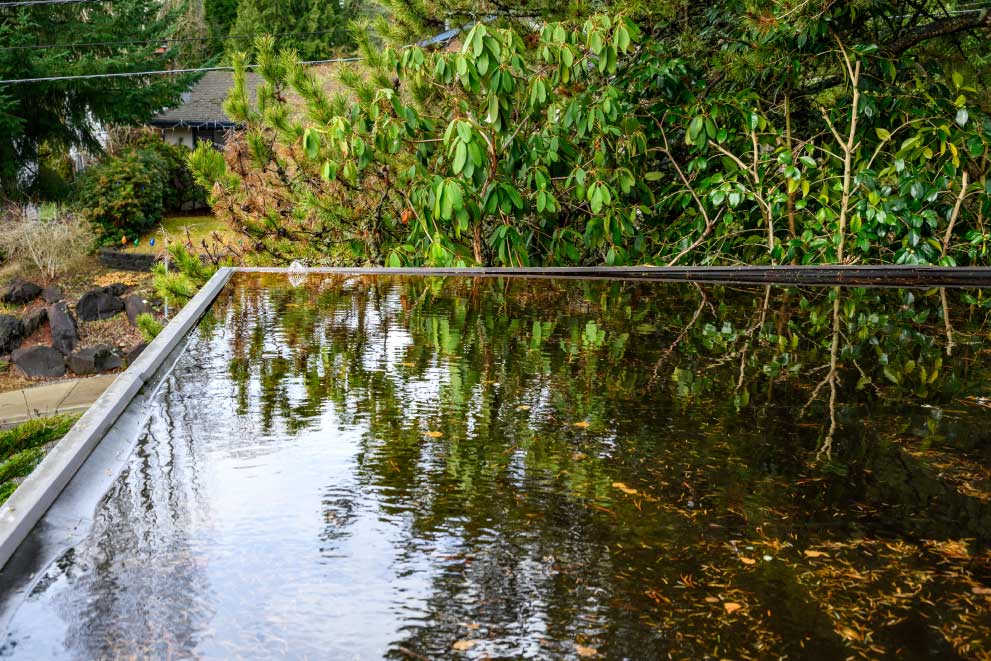
In commercial roofing, ponding generally refers to water that remains on a roof for an extended period after rainfall has stopped and normal drying conditions have returned.
There is no single time limit that applies to every roofing system, but 48 hours is a commonly used industry benchmark. NRCA research into manufacturer policies found that many Modified Bitumen, EPDM, built up, TPO, and PVC manufacturers use 48 hours as an acceptable maximum ponding period, although requirements vary by manufacturer and roofing system.
That distinction is important.
If a shallow puddle forms during a storm and disappears several hours later, that is very different from returning two days later and finding essentially the same puddle in the same location.
The second condition deserves attention.
It does not necessarily mean the roof needs to be replaced. It means something about the roof’s drainage should be investigated.
A Flat Roof Should Still Drain
The term “flat roof” is somewhat misleading.
Commercial flat roofs are actually low slope roofs, designed with enough pitch to move water toward their drainage points. The slope may be built directly into the structural deck, created with tapered insulation, or achieved through a combination of the two.
The National Roofing Contractors Association recommends that roof systems be designed to provide positive drainage because persistent ponding can be detrimental to roofing systems.
On a large commercial building, that drainage pattern can be surprisingly sophisticated. Water may travel considerable distances through slight valleys in the roof before reaching an internal drain. Other buildings direct water toward perimeter scuppers or gutters.
This means a property owner should not judge drainage simply by looking at whether the entire roof appears perfectly level. What matters is whether water is reaching the places it was designed to go.
Why Does Water Start Ponding on a Commercial Roof?
There are several common causes, and they do not all require the same solution.
| Possible Cause | What Is Happening | Typical Response |
|---|---|---|
| Blocked roof drain | Leaves, debris, vegetation, ice, or other material restricts drainage | Clean and inspect the drain |
| Settled insulation | The roofing assembly develops a localized depression | Evaluate the affected area and drainage |
| Structural deflection | Part of the deck has lowered and created a basin | Roofing and structural evaluation may be required |
| Poor original slope | The roof never drained properly in a particular area | Consider tapered insulation or drainage modifications |
| Raised drain | The drain sits slightly higher than the surrounding roof | Correct the drainage detail when practical |
| Previous roofing work | Repairs or additional roof layers have changed the original drainage pattern | Assess whether localized correction is possible |
| Snow and ice | Meltwater cannot reach a frozen or obstructed drain | Seasonal monitoring and safe drain maintenance |
A blocked drain is obviously much easier to correct than a roof deck that has changed elevation. That is why identifying the cause matters before anyone starts proposing larger roofing work.
What Our Expertise Has Taught Us
One of the most useful things a property manager can do is pay attention to where water repeatedly appears.
A photograph taken a day after several different rainstorms can reveal a pattern. If the same area is holding water every time, particularly if that area is becoming larger, the issue is worth documenting and inspecting.
That information can be much more useful than waiting until water finally reaches the interior of the building.
Are Small Puddles on a Flat Roof Normal?
Sometimes.
Commercial roofing is built at a very shallow slope, and real buildings are not perfectly uniform. Minor depressions, construction tolerances, deck movement, and roof penetrations can create small areas where water drains more slowly than the surrounding surface.
The presence of a puddle by itself therefore does not tell you very much.
Its depth, size, duration, location, and frequency matter more.
A small shallow area that evaporates relatively quickly may not justify corrective work. A large area that remains for days after every rainfall is a different situation, especially if it is located around seams, flashing details, previous repairs, or deteriorated membrane.
The condition of the roofing system also matters. A small amount of ponding on a relatively new, properly installed membrane is not the same as persistent water sitting over a twenty year old roof with cracking and previous leak repairs.
Roof drainage should always be evaluated in context.
Why Persistent Ponding Water Matters
Water does not automatically destroy a commercial roofing membrane simply because it touches it. Roofing systems are obviously designed to withstand rain.
The concern is what happens when the roof is subjected to standing water repeatedly over long periods.
It exposes weak points for longer
Rain that drains quickly has limited opportunity to find a vulnerable seam, puncture, flashing detail, or aging repair.
Standing water remains in contact with those areas for much longer.
If the membrane is already compromised, ponding can make an existing weakness considerably more consequential.
It can accelerate deterioration in some roofing systems
Manufacturers have different requirements regarding ponding water, which is one reason warranty documentation and system specifications matter.
Some membranes tolerate standing water better than others, but no property owner should assume that persistent ponding is desirable simply because the roof has not leaked yet.
Dirt and organic material begin collecting
Low areas tend to accumulate dirt, leaves, sediment, and other debris as water evaporates.
Over time, those areas can become increasingly visible and may even support vegetation if maintenance is neglected.
The accumulated material can then make drainage even worse, creating a cycle in which a small drainage problem gradually becomes more pronounced.
Freeze and thaw cycles add another variable in Ontario
Ontario commercial roofs spend part of the year dealing with conditions that roofing systems in warmer climates rarely experience.
Standing water can freeze, thaw, and freeze again. Snow can also obstruct normal drainage paths while melting water moves beneath or around it.
This does not mean that every frozen puddle is damaging a roof, but persistent drainage problems deserve more attention in a climate where water regularly changes between liquid and solid states.
Water adds weight
Water is heavy.
A relatively shallow amount spread over a small area is generally not a structural concern on a properly designed building, but the load increases quickly as the area and depth increase.
More importantly, if structural deflection is already contributing to a drainage problem, additional water can deepen the low area and allow even more water to collect.
This is one reason unusually deep or extensive ponding should not simply be dismissed as a roofing maintenance issue.
Not All Water Retention Is Accidental
There is an important exception that commercial property owners should know about.
Some buildings intentionally use flow control roof drains that temporarily hold stormwater on the roof and release it gradually.
The 2024 Ontario Building Code recognizes this type of design and requires the building structure and drainage system to account for the stored water. The Code commentary specifically addresses flow control drains, and current Ontario requirements include limits on drain down time along with structural and overflow provisions.
In other words, water remaining on a roof does not automatically indicate poor drainage.
If the building was intentionally engineered to use controlled roof drainage, temporary water storage may be part of the design.
This is another reason a roofing contractor should understand the building before recommending a correction. Trying to “fix” intentional water retention without understanding the drainage design could create a different problem.
Roof Drains Need Maintenance Too
Commercial roof drains are easy to forget because most building occupants never see them.
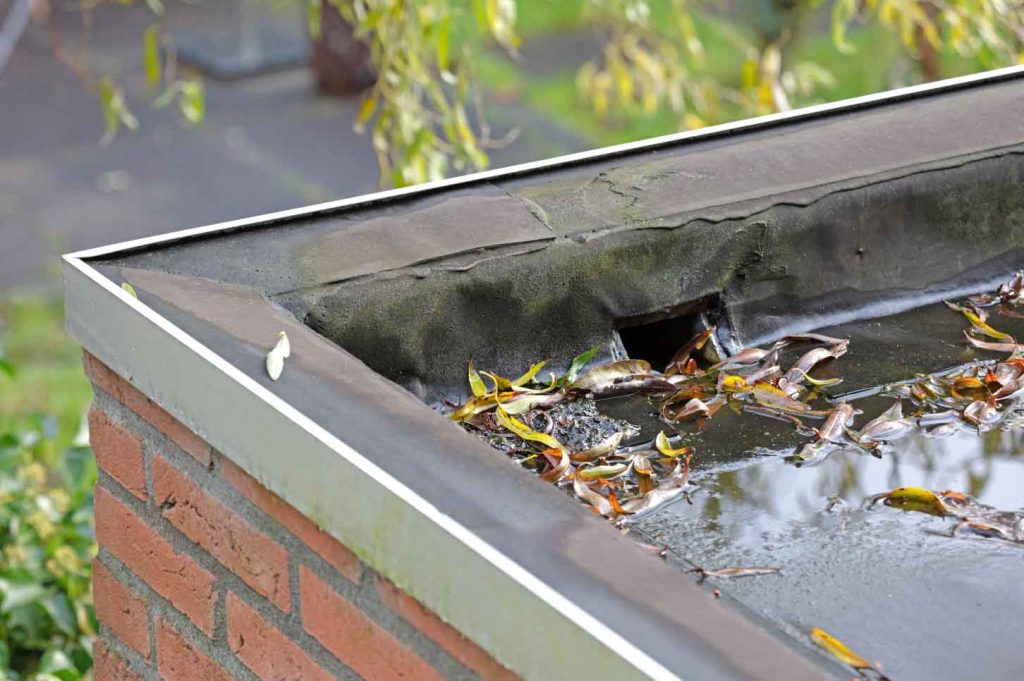
Unfortunately, they are also exposed to leaves, dirt, roofing granules, packaging, bird activity, vegetation, and debris from other contractors working on the building.
A drain does not have to be completely blocked to cause problems. Partial obstruction can slow the rate at which water leaves the roof, particularly during a heavy storm.
Drain baskets should therefore be checked as part of routine roof maintenance, along with scuppers, gutters, and the areas immediately surrounding them.
This work should be performed with proper roof access and fall protection procedures. Ontario provides specific safety guidance for construction work on flat roofs, and property owners should avoid sending untrained employees onto a commercial roof simply to clear a drain.
See our article about flat roof maintenance for tips on maintaining your drains and roof.
What If the Drain Is Clear but Water Still Ponds?
This is where the problem becomes more interesting.
If a drain is functioning properly but water stops several feet away from it, the issue is probably not the drain itself.
The roof may contain a low area between the pond and the drainage point.
On older commercial roofs, this can happen because insulation has compressed or settled. Roof decks can also deflect over time, particularly around areas that experience loading or structural movement.
Other roofs simply did not have enough slope from the beginning.
In those situations, the solution could involve:
- Building slope with tapered insulation
- Installing or relocating drainage
- Correcting localized low areas
- Modifying drainage during a future roof replacement
- Monitoring a minor condition if correction would provide little practical benefit
The right response depends on how severe the ponding is and what condition the rest of the roof is in.
A perfectly dry roof after every rainfall is ideal, but spending significant money to correct a tiny cosmetic puddle on an otherwise healthy commercial roof may not provide much value.
That distinction is where experienced judgment becomes important.
Can Tapered Insulation Fix Ponding Water?
Often, yes.
Tapered insulation is one of the most useful tools available when a commercial roof needs improved drainage.
Instead of installing insulation at one uniform thickness, tapered systems use insulation of varying thicknesses to create intentional slopes and drainage paths across the roof.
This can help direct water toward existing drains without changing the structural roof deck.
Tapered insulation is particularly useful during roof replacement or major restoration because the drainage design can be considered as part of the entire roofing assembly.
Trying to correct isolated drainage problems on an existing roof is possible in some cases, but the transition between new and existing elevations needs to be carefully considered. Otherwise, correcting one low point can simply move the water somewhere else.
When Should Ponding Water Be Inspected?
Property managers do not need to call a roofing contractor every time they see water after a thunderstorm.
What matters is whether there is evidence of a recurring drainage problem.
An inspection makes sense when:
- Water remains for roughly 48 hours or longer under normal drying conditions.
- The same area ponds after nearly every rainfall.
- A previously dry portion of the roof has started collecting water.
- The ponding area appears to be increasing in size or depth.
- Water is collecting around flashing, seams, penetrations, or previous repairs.
- Interior leaks are occurring below or near the area.
- A drain repeatedly becomes blocked.
- The roof surface appears noticeably depressed.
Deep, widespread, or rapidly worsening ponding deserves more immediate attention because the roofing system or structure may need a closer assessment.
Common Mistake: Treating the Puddle Instead of the Cause
It is possible to repair the membrane underneath a pond without fixing the reason the pond exists.
Sometimes that is appropriate. If the drainage condition is minor but the membrane has a localized defect, repairing the defect may be all that is necessary.
In other cases, it only addresses half of the problem.
If a low area exists because insulation has collapsed, repeatedly coating or patching the membrane will not restore the original slope. Likewise, replacing a drain basket will not help if the drain itself sits above the surrounding roof surface.
The best solution starts by identifying why the water is there.
Ponding Water on an Older Roof Deserves More Attention
The age and condition of a roofing system can significantly change how ponding should be viewed.
On a newer roof with healthy membrane and properly constructed details, a minor drainage deficiency might simply be documented and monitored.
On an older roof that already has numerous repairs, deteriorating flashing, brittle membrane, or a history of leaks, the same amount of standing water becomes more concerning.
This ties directly into the broader repair versus replacement decision.
If ponding is one isolated deficiency, improve the drainage if practical and preserve the roof.
If it is one of several signs that the roofing system is declining, it may make more sense to incorporate drainage improvements into a larger restoration or replacement project.
What Should Property Managers Look for After Heavy Rain?
You do not need to become a roofing inspector to manage drainage intelligently.
If your building has an established roof maintenance program, simply make drainage part of the documentation.
After significant weather, qualified personnel can record where water is collecting and compare those observations with previous inspections.
Over time, that creates a useful history.
The important questions are fairly simple:
Is the water draining?
Is it always collecting in the same place?
Is the condition getting worse?
Is the membrane underneath it still in good condition?
Has the building experienced leaks in that area?
Those answers provide far more useful information than simply noting that “there is water on the roof.”
How Garcia Roofing Approaches Drainage Problems
At Garcia Roofing, drainage is evaluated as part of the roofing system rather than as an isolated feature.
The location and condition of drains matter, but so do roof elevations, membrane condition, insulation, flashing, previous repairs, and the age of the system.
Sometimes the solution is straightforward, such as clearing an obstruction or correcting a localized detail.
Other situations require a larger discussion about tapered insulation, additional drainage, structural conditions, or how the issue should be addressed during a future replacement.
The objective is not to eliminate every visible drop of water at any cost. It is to determine whether the roof is draining as intended and whether any remaining water is creating a meaningful risk to the roofing system or the building below it.
That approach is consistent with how Garcia Roofing looks at commercial roofing as a whole.
We’re not just here for today, we’re here for tomorrow.
Frequently Asked Questions
How long is it acceptable for water to sit on a flat roof?
There is no universal requirement for every roofing system, but 48 hours after rainfall under normal drying conditions is commonly used as an industry benchmark. Manufacturer requirements vary, so the specifications and warranty for the particular roofing system should also be considered.
Does ponding water mean my commercial roof needs replacement?
No. Ponding can result from something as simple as a blocked drain or a localized low area. Replacement becomes more relevant when drainage problems occur alongside widespread membrane deterioration, wet insulation, repeated leaks, or other signs that the roof is reaching the end of its useful life.
How do you fix standing water on a flat roof?
The solution depends on the cause. Clearing drains, repairing localized low areas, installing tapered insulation, modifying drainage, or correcting roof elevations are all possible solutions.
Can a flat roof have zero standing water?
Ideally, a commercial roof should provide positive drainage, but minor shallow areas can occur because of real world construction tolerances and building movement. The duration and extent of the ponding are generally more important than expecting the entire roof to become perfectly dry immediately after every storm.
Can ponding water cause a commercial roof to leak?
Ponding does not automatically cause a sound roofing membrane to leak. It can, however, increase exposure at existing weaknesses and become more concerning as the membrane ages or deteriorates.
Final Thoughts
A puddle on a commercial roof is not a diagnosis, it’s information. What matters is what happens to that water next.
If it drains normally after the storm, there may be little reason for concern. If it remains for days, repeatedly returns to the same area, or appears alongside membrane deterioration and recurring leaks, the roof is telling you something worth investigating.
Good commercial roof maintenance is largely about noticing those patterns before they become emergencies.
Drainage is a particularly useful example because relatively minor problems are often visible long before they cause interior damage. A clogged drain, developing low area, or changing drainage pattern can be identified and addressed while the roofing system is still functioning.
That is a much better position to be in than discovering the problem when water starts coming through the ceiling.