A commercial roof inspection should leave you with more than a verbal opinion.
If someone walks your roof, comes back down and tells you that it is “in pretty good shape” or that “you’ll probably need to replace it soon,” you have learned very little. Those statements may be accurate, but they do not give a property owner enough information to budget, compare options, plan future work, or explain a roofing expense to someone else in the organization.
That is where a commercial roof condition report becomes useful.
A good report turns an inspection into something tangible. It documents what roofing system is currently on the building, what condition it is in, where problems were found, which issues deserve attention now, and what the owner should reasonably expect from the roof going forward.
For a facility manager responsible for one building, that creates a useful maintenance record. For a property manager overseeing a portfolio, it can become part of a much larger capital planning process.
The important part is that the report actually helps somebody make a decision.
A Roof Condition Report Is Different From a Repair Quote
These two documents are sometimes treated as if they serve the same purpose.
They do not.
A repair quote tells you what a contractor proposes to fix and how much that work will cost. A roof condition report should explain why the work is being recommended in the first place.
That distinction becomes particularly important when a commercial roof is aging.
Imagine an inspection identifies several deficiencies. One contractor might recommend repairing them for a relatively modest amount. Another might suggest replacing the entire roofing system.
Without documentation of the roof’s actual condition, the owner is left comparing two prices rather than two strategies. A useful condition report provides the context needed to understand those recommendations.
Industry inspection guidance follows the same general principle. NRCA guidance recommends documenting roof construction and condition, previous repairs, drainage, membrane and flashing conditions, and providing the owner with findings, locations of identified problems, recommended corrective actions and repair information.
Start With What Is Actually on the Roof
Before discussing what is wrong with a roof, the report should establish what is there.
Commercial buildings are not always as straightforward as they appear from below. A building may contain several roof sections installed at different times. One portion may use Modified Bitumen while an addition uses a single ply membrane. Another section may have been recovered over an older roof rather than fully replaced.
A useful report should identify as much of the existing assembly as can reasonably be determined.
That normally includes information such as:
| Roof Information | Why It Matters |
|---|---|
| Roofing system | Different membranes age and fail differently |
| Approximate age | Helps put observed deterioration into context |
| Roof areas or sections | Large buildings may contain several different systems |
| Insulation, where known | Important for thermal performance and moisture concerns |
| Drainage type | Helps explain ponding and water movement |
| Rooftop equipment | Penetrations and equipment affect maintenance and leak risk |
| Previous repairs | Reveals recurring problem areas and maintenance history |
Not every inspection will be able to identify every component without drawings, test cuts or additional investigation. The report should distinguish between what was observed, what is known from records, and what has been assumed.
That is far more useful than presenting assumptions as facts.
Photographs Should Show More Than That Someone Was on the Roof
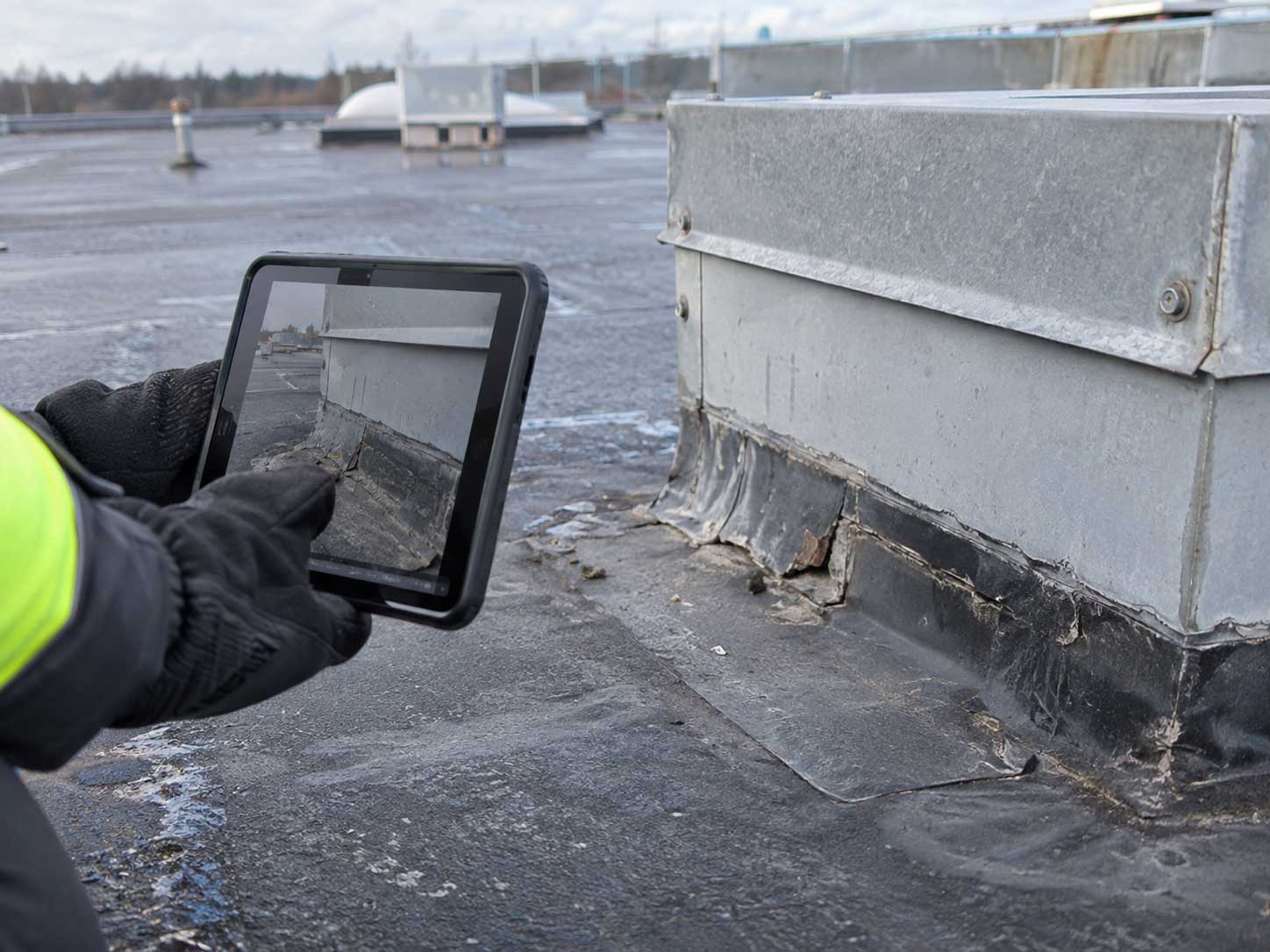
Photos are one of the most valuable parts of a commercial roofing report when they are used properly. A collection of twenty rooftop photographs without explanation is not particularly helpful.
The photographs should make the findings easier to understand.
If a flashing is deteriorating, the report should show the flashing. If water is collecting in one area, the ponding location should be documented. If a previous repair is failing, the owner should be able to see what the inspector is referring to.
NRCA inspection guidance specifically recommends photographs as a way to document what was inspected and why, while noting that photographs should be identifiable so they remain useful later.
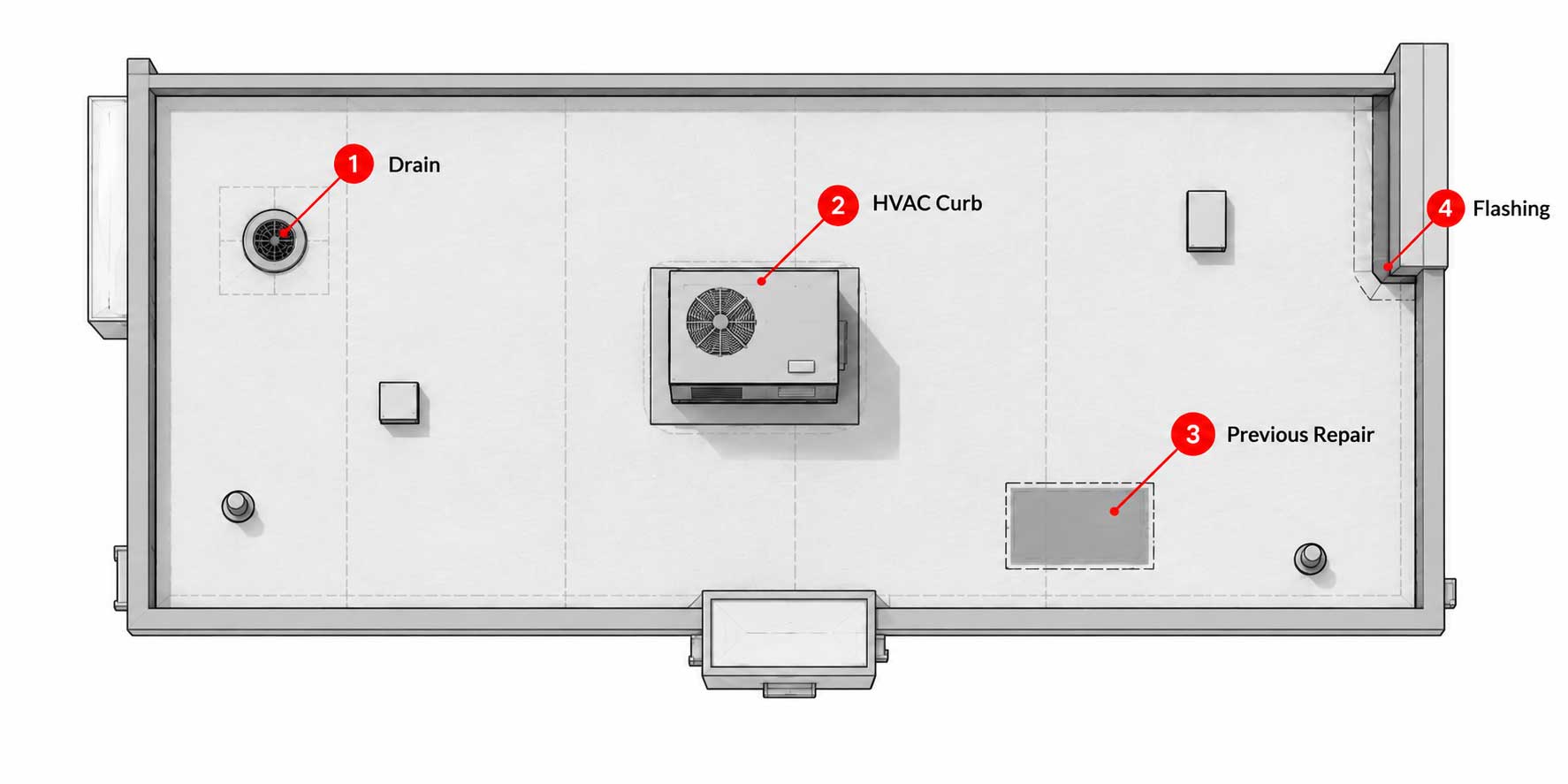
For larger commercial roofs, location matters too. A close photograph of a defect is much more useful when the report also makes clear where that defect is located.
That could mean including a wider context photograph, marking locations on a roof plan, or assigning reference numbers to different roof areas.
A facility manager should be able to return to the roof six months later and identify the same location.
The Membrane Condition Should Be Explained in Plain Language
The roofing membrane is the primary waterproofing layer, but a report should not assume that the property owner understands every technical term associated with it.
The report may document conditions such as open seams, punctures, cracking, blistering, surface wear, membrane shrinkage or deteriorated repairs. Those are useful observations, but they should also be accompanied by context.
For example:
A small puncture was identified approximately two metres east of the rooftop HVAC unit. The surrounding membrane remains in good condition. Localized repair is recommended.
That tells the owner considerably more than:
Membrane damaged. Repair required.
The first version explains the extent of the problem and, importantly, suggests that the issue appears isolated.
That difference matters when somebody is deciding whether the roof needs a $1,000 repair or a six figure replacement project.
Flashings and Penetrations Deserve Their Own Attention
Many commercial roof problems develop where the main roof surface meets something else. That includes walls, parapets, mechanical curbs, pipes, vents, skylights, drains and other penetrations. These transitions rely on properly installed flashing to keep water out while accommodating movement between different materials.
As the building and roofing system age, those areas can become vulnerable.
A condition report should therefore document the state of important flashing details rather than simply describing the broad roof membrane as “good” or “fair.”
NRCA condition assessment materials specifically evaluate membrane condition, flashing condition, membrane to metal connections, drainage and mechanical equipment as separate components of the roof.
That is a useful way to think about a commercial roof generally. A roof is not one surface. It is a collection of details and materials that need to work together.
Drainage Should Be Documented, Not Just Mentioned
If a commercial roof is holding water, the report should explain where and provide some indication of why.
A blocked drain is different from a structural low point. A small shallow depression is different from a broad area that remains covered in water long after rainfall.
The report should document conditions around internal drains, scuppers, gutters and visible drainage paths. Ponding areas should be photographed and, where practical, their location should be recorded so they can be monitored over time.
This becomes particularly important in Ontario because snow, ice and repeated freezing and thawing can complicate drainage throughout the year.
We discuss this issue in more detail in our guide to flat roof drainage and ponding water in Ontario, but the important point in a condition assessment is simple: standing water should not just be photographed. It should be interpreted.
Previous Repairs Tell Part of the Roof’s Story
One patch on an otherwise healthy roof is usually not alarming, however twenty patches tells you something different. A condition report should identify previous repairs and note whether they appear to remain serviceable.
This is one of the areas where a report becomes more valuable each time the roof is inspected. If the same area has been repaired repeatedly, or if new repairs are appearing across different sections every year, the maintenance history begins to reveal a pattern. That pattern may eventually influence whether continued repair makes financial sense.
For this reason, building owners should keep previous condition reports rather than treating each inspection as an isolated event. A commercial roof is much easier to understand when you can compare what it looked like three years ago with what it looks like today.
Our Thoughts
A single photograph can show you what a roof looks like today. A series of inspection reports can show you how quickly it is changing.
That distinction is particularly useful when planning replacement.
A roof that has looked essentially the same for several years may still have substantial useful life. A roof developing new deficiencies every six months deserves a different level of attention, even if none of the individual defects appears catastrophic.
Moisture Concerns Should Be Identified Clearly
One of the limitations of a visual roof inspection is that much of the roofing system is hidden. The membrane may look acceptable while insulation below it has been affected by previous water infiltration.
That does not mean every inspection requires invasive testing. It does mean, however, that a good report should identify evidence that may justify additional investigation.
For example, recurring leaks, soft areas, widespread repairs or signs of trapped moisture may lead a contractor to recommend further assessment.
Depending on the building and situation, additional investigation might involve moisture scanning, test cuts or other diagnostic methods. The important thing is to separate observations from conclusions.
If wet insulation has actually been confirmed, say so.
If it is only suspected, the report should say that further investigation is required.
Every Deficiency Should Not Have the Same Priority
This is one of the areas where condition reports can either become extremely useful or almost useless.
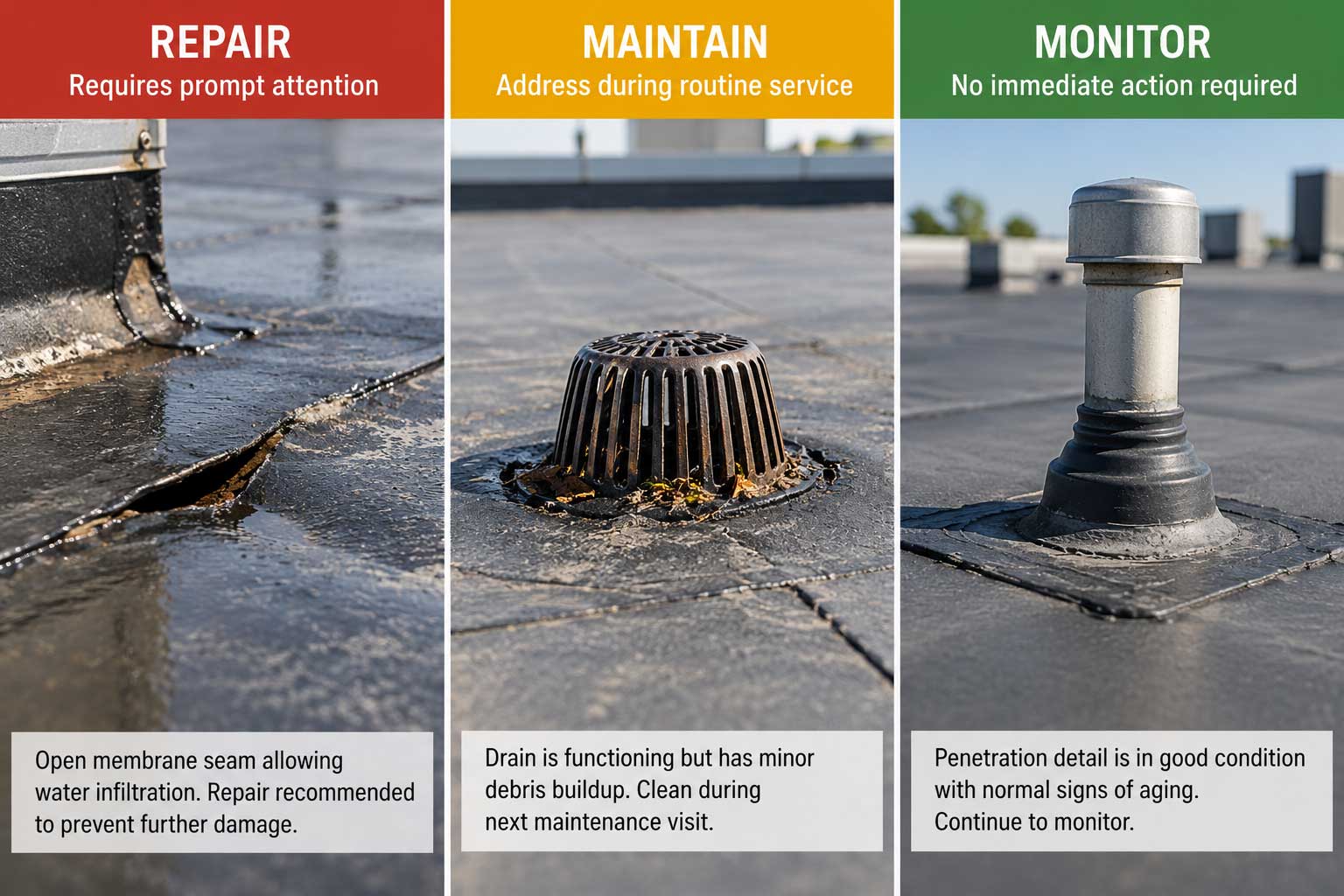
If twenty deficiencies are documented and all twenty are presented with the same urgency, the building owner is left to figure out what should happen first.
A better approach is to prioritize them.
The terminology can vary, but a simple system might look like this:
| Priority | Meaning | Typical Response |
|---|---|---|
| Immediate | Active leak, serious membrane opening, blocked critical drainage or another significant concern | Correct promptly |
| Short term | Defect likely to worsen or create leakage | Schedule repair |
| Maintenance | Minor condition that should be addressed during normal service | Include in maintenance work |
| Monitor | No immediate repair required | Photograph and reassess during future inspection |
This turns the document into a management tool.
FM’s current roof inspection guidance similarly distinguishes conditions that should be corrected promptly, including membrane and flashing deficiencies, wet insulation, clogged drainage and defects that allow water into the roofing system or building.
The exact categories matter less than giving the owner a rational sequence.
A Good Report Should Discuss Options, Not Just Problems
This becomes particularly important on older roofs.
Suppose an inspection identifies several deficiencies. The contractor might reasonably present three possibilities:
- Repair the affected areas and continue maintaining the roof.
- Perform more extensive restoration work to extend its service life.
- Begin planning replacement.
A useful condition report explains why one option makes more sense than another.
This is where information about age, repair history, membrane condition, moisture, drainage and expected service life comes together.
The recommendation should not simply say:
Replace roof.
It should explain the decision.
For example:
The membrane remains repairable, but deterioration is occurring across several unrelated areas and repair frequency has increased over the past two years. Local repairs can address current deficiencies, although the owner should begin budgeting for replacement within the next three to five years.
That gives a property owner something they can actually plan around.
Budget Guidance Makes the Report More Valuable
Not every roofing contractor will provide detailed costing within a condition assessment, but some level of budget guidance can be extremely helpful.
The purpose is not necessarily to provide a final construction quotation.
It is to distinguish between:
- A small maintenance item,
- A meaningful repair project,
- A future capital expense.
If a property manager oversees ten buildings, knowing that one roof may require replacement in two years while another likely needs only routine maintenance is enormously useful.
That is where roof inspections move beyond maintenance and become part of capital planning.
What Should the Final Report Include?
A practical commercial roof condition report should generally provide enough information to answer the following questions:
- What roofing system is on the building?
- Approximately how old is it?
- What condition is the membrane in?
- What condition are the flashings and penetrations in?
- Is the roof draining properly?
- Are previous repairs holding up?
- Is there evidence of leakage or possible moisture within the assembly?
- What deficiencies were identified?
- Where are they located?
- Which items require immediate attention?
- Which items can be monitored?
- What repairs are recommended?
- Does the roof appear suitable for continued maintenance?
- Should the owner begin planning restoration or replacement?
- What should happen next?
If the report answers those questions clearly, it has done considerably more than document a roof inspection.
It has created a plan.
Common Mistake: Treating the Report as a Sales Proposal
A condition report loses credibility quickly if every finding conveniently leads to the most expensive available solution.
Sometimes a roof needs replacement, sometimes it does not.
A ten year old commercial roof with one failed flashing detail should not be treated the same way as a twenty five year old roof with widespread deterioration and wet insulation.
Property owners should expect a condition assessment to distinguish between those situations.
There is nothing wrong with a contractor providing repair or replacement pricing after the assessment. In fact, that can be very useful.
The important part is that the recommendation follows from the evidence rather than the report simply being built around the recommendation.
How Garcia Roofing Approaches Roof Condition Assessments
For Garcia Roofing, a commercial roof assessment should help the owner understand both the immediate condition of the roof and the larger decision that follows from it.
That means documenting the roofing system, identifying deficiencies, looking at drainage and critical details, considering previous repairs, and separating immediate issues from conditions that can be monitored.
The objective is not to make every roof look like a replacement project.
It is to provide enough information for an owner, property manager or facility manager to make a sensible decision about what happens next.
Garcia Roofing works with commercial and industrial flat roofing systems throughout Ontario and holds seven manufacturer certifications across the systems it installs and services.
Whether the right recommendation is maintenance, repair, restoration or eventual replacement depends on the building.
The report should make the reasoning clear.
We’re not just here for today, we’re here for tomorrow.
Frequently Asked Questions
What is a commercial roof condition report?
A commercial roof condition report documents the current state of a roofing system following an inspection. It typically identifies the roofing system, membrane and flashing condition, drainage concerns, previous repairs, deficiencies, recommended corrective work and areas that should continue to be monitored.
Is a roof condition report the same as a roof inspection?
The inspection is the physical assessment of the roof. The condition report is the documented result of that inspection. A thorough commercial assessment should normally produce written findings that the property owner can retain and reference later.
Should a roof inspection report include photographs?
Photographs are highly useful because they document specific deficiencies and create a visual record that can be compared with future inspections. Industry guidance recommends using photographs to help identify and explain observed roof conditions.
Can a roof condition report tell me how long my roof has left?
It can provide an informed estimate, but remaining service life is not an exact calculation. Installation quality, material, age, moisture, drainage, previous maintenance and future weather exposure all affect how long a commercial roofing system will continue performing.
Does a roof condition assessment require moisture testing?
Not necessarily. Many assessments begin with a visual inspection and review of available information. If the findings suggest that moisture may be present within the roofing assembly, further investigation may be recommended.
When should a commercial building get a roof condition assessment?
An assessment can be useful when purchasing or managing a building, planning capital expenditures, investigating recurring leaks, evaluating an aging roof, considering repair versus replacement, or establishing a preventative maintenance program.
Final Thoughts
The most useful commercial roof inspection is not the one that identifies the largest number of defects.
It is the one that leaves the property owner with the clearest understanding of what those defects mean.
A good condition report should tell you what you have, what condition it is in, what needs attention, what can wait, and what you should begin planning for.
That information becomes increasingly valuable as the roof ages because major roofing decisions rarely need to be emergencies.
When owners have accurate documentation and several years of condition history, replacement can be budgeted before recurring leaks force the issue, repairs can be prioritized intelligently, and roofs that still have useful life can continue operating rather than being replaced unnecessarily.
That is ultimately what a commercial roof condition report should provide: better information for better decisions.